
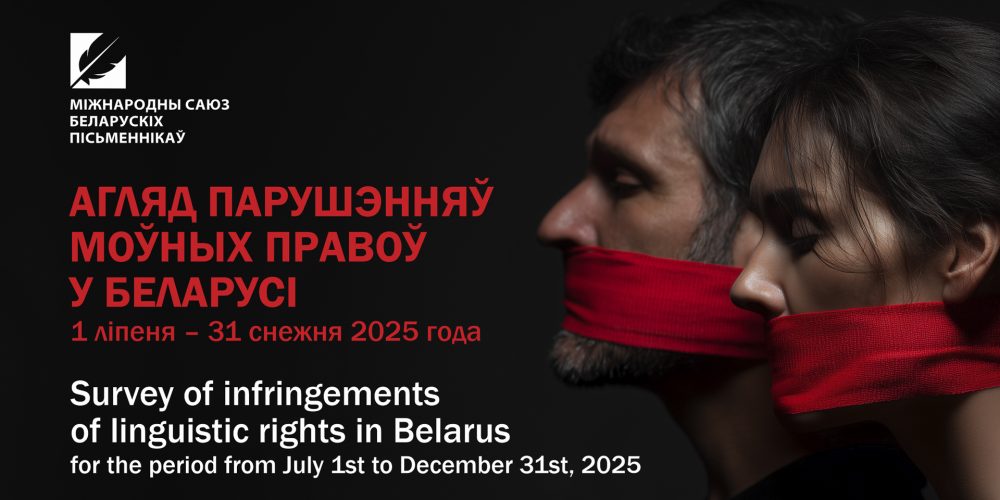
The Belarusian language is an integral element of the cultural identity of the people of Belarus and has the status of a state language in accordance with the Constitution of the Republic of Belarus. The right of an individual to use his/her native tongue, including in the spheres of education, access to information, participation in cultural life and communication with state authorities, is an inseparable part of cultural human rights.
These rights are guaranteed by both national legislation and international obligations of the Republic of Belarus, in particular the International Covenant on Civil and Political Rights and the International Covenant on Economic, Social, and Cultural Rights, which Belarus is a participant of.
Despite the formal establishment of the equal status of the Belarusian language in the Constitution of the Republic of Belarus and the state’s international legal obligations, in practice the Belarusian language is subjected to systematic marginalization and discrimination. Its use is consistently restricted in key areas of public life, including education, public administration, the judiciary, penitentiary institutions, state-run cultural institutions, the media, and public space.
During the reporting period, numerous cases were recorded where the use of the Belarusian language provoked negative attitudes from government officials, led to administrative pressure or punitive measures. Cultural figures, journalists, persons deprived of their liberty, and representatives of civil society were particularly vulnerable, which indicates the use of the language as a tool of systemic discrimination and pressure.
The documented facts presented below demonstrate that the restrictions on the use of the Belarusian language are not accidental or episodic. Au contraire, they indicate the existence of a persistent, institutionalized practice of discrimination, carried out with the participation or tacit consent of state bodies. Such practices include both active actions and inaction, including want of effective mechanisms to ensure the right to use the Belarusian language, as well as the use of repressive measures against individuals who insist on exercising their linguistic rights.
The described actions are incompatible with the international human rights obligations of the Republic of Belarus, including the obligation to respect, protect, and ensure cultural rights without discrimination. They also undermine the principles of equality before the law, respect for human dignity and cultural diversity, contributing to the systematic displacement of the Belarusian language from the current social and cultural space.
The association “International Union of Belarusian Writers” continues to systematically monitor the situation of the Belarusian language in the Republic of Belarus and records cases of discrimination against the language and its speakers with the aim of their further documented assessment and use within the scope of international mechanisms for the protection of human rights.
In the second half of 2025, the following cases were recorded in open sources of information, indicating discriminatory practices against the Belarusian language.
On July 3, 2025, the state propagandist Dmitry Zhuk appeared on the TV show “Editors’ Club” on the first news channel news.by and stated the need to preserve, inter alia, the Russian language as a means of “protecting” Belarus from the external “impact”. In the context of general state rhetoric, such a statement actually presents the Belarusian language as a threat to national security and contributes to its stigmatization in the public space.
On July 3, 2025, a citizen of Belarus named Iryna reported on the social network Threads about a problem that has to do with the transliteration of her name into Latin letters from the Belarusian language. She noted that the existing version of the transliteration causes her great indignation and does not comply with the Belarusian language norm. According to the Instruction on the procedure for transliterating surnames and names of citizens of the Republic of Belarus when including their personal data in the population register, approved by the resolution of the Ministry of Internal Affairs of the Republic of Belarus d/d October 9, 2008 No. 288, transliteration should be carried out from the correct spelling of the name in Belarusian or Russian, recorded in documents confirming the identity.
On July 7, 2025, a cultural evening dedicated to the Belarusian poet Larysa Hienijus was planned to be held at the Parason Gallery in Minsk (8 Drazda Street). The announced event sparked a massive information attack from state propagandists and pro-government commentators. After public pressure and a negative campaign in state-run and pro-state media, the announcement of the evening was removed, and the event was canceled.
On July 11, 2025, the President of the Russian Federation Vladimir Putin signed a decree “On Approval of the Fundamentals of the State Language Policy of the Russian Federation”, which declares the Russian language a “national asset” and an element of the civilizational unity of the so-called “Russian World”. In the context of close political and ideological integration between the Republic of Belarus and the Russian Federation, such an approach has a cross-border impact and contributes to the hierarchization of languages, effectively giving the Russian language a privileged status to the detriment of other languages, including Belarusian.
On July 17, 2025, in the city of Lida, on the occasion of the Day of Belarusian Writing, an alley of art benches dedicated to book themes was installed on Hiedymin Boulevard. All text inscriptions on the benches were made exclusively in Russian.
On July 22, 2025, the Book Chamber published a report on the publishing of book products for 2024. According to official data, in 2024, the overwhelming majority of book publications was Russian-language products — 80.9%. Books in Belarusian were 12.5%, publications in other languages — 6.6%. In absolute terms, 893 book titles were released in Belarusian with a total circulation of 3.1 million copies. The largest share of Belarusian-language publications was recorded in the segment of children’s literature: in the genre of folklore (fairy tales), about half of the books are published in Belarusian, in the segment of fiction — about 26%.
July 23, 2025. A user of the social network Instagram published a video post in which she demonstrated cases of negative attitudes on the part of individual citizens towards the use of the Belarusian language in everyday communication.
On July 24, 2025, it became known that the Janka Kupala National Academic Theater had introduced a new service – holding a solemn marriage registration ceremony. According to the service description, the ceremony itself is held in Russian, and the marriage certificate is issued exclusively in Russian.
On July 24, 2025, the former political prisoner and citizen of the Republic of Latvia Dmitrijs Michailovs in an interview with Radio Svaboda reported on the facts of discrimination against prisoners who use the Belarusian language in penitentiary institutions of the Republic of Belarus. According to his testimony, Belarusian-speaking prisoners were subjected to systemic pressure, including physical violence, for attempting to use the Belarusian language in everyday communication.
On July 29, 2025, a public statement by a private individual was published in the Belarusian media, in which the use of the Belarusian language in everyday communication was characterized as “inconvenient” and “unacceptable” without the prior permission of the interlocutor. The Belarusian language was presented as a damaged form of the Russian language.
On August 2, 2025, a case of persecution of a prisoner for using the Belarusian language in a correctional facility became known. According to published information, Ivan (name changed for security reasons), convicted under a political article, was twice placed in a penal isolation cell (punitive isolation ward) for attempting to speak Belarusian while serving his sentence.
On August 4, 2025, the Ministry of Information of the Republic of Belarus announced the addition of 31 more titles to the list of printed publications banned for distribution in the country. Among those included in the list is the collection “Here They Are, and Here We Are. Belarusian Poetry and Poems of Solidarity” (compiled by Uladzimir Karkunou). The book, published in 2021 in the Russian Federation, collects poems by modern Belarusian poets in the original and in translation, as well as texts published on the polutona.ru portal in August 2020.
August 5, 2025. In response to the appeal of the language activist and human rights defender Ihar Slucak the Ministry of Economy reported that out of 3,044 regulatory legal acts issued by the agency, only 3 were adopted in Belarusian, which is 0.1% of the total.
On August 27, 2025, the director of the National Theater of Belarusian Drama Svetlana Naumenko announced the launch of a special project “NTBD on Mondays”. The project plans to stage productions of Russian classical drama in Russian. According to her, this format is justified by the fact that Russian classics are considered a “cultural space” that can contribute to the development of the troupe and international ties. It was also announced the intention to include the works of the Russian writer Zakhar Prilepin in the repertoire, including the production of “Chavs’ Tales” [“Patsanskiye Rasskazy”]. It was noted that communication is underway with the Russian director Yuri Pakhomov regarding the possible implementation of the production.
The director also reported that the theater is considering touring the Russian Federation and is focusing, among other things, on the Russian audience.
On August 30, 2025, it became known that in Zaslauje, where this year’s regional harvest festival was held, 10 city murals were prepared as a decoration for the city. One of the murals depicts the 16th-century enlightener and printer Symon Budny, with a quote in Russian next to the image: “There are no books from which you cannot learn something”. Note that the Russian language appeared on Belarusian lands only 200 years after the death of the enlightener.
On September 5, 2025, in response to the request of the language activist and human rights defender Ihar Slucak to provide technical documentation for products in Belarusian, the JSC Gomselmash announced a refusal. The response noted that the use of Belarusian in technical documentation, in the opinion of the company, may cause disputes in the understanding and perception of technical terms among a significant part of consumers.
September 7, 2025. The Deputy Prime Minister of the Republic of Belarus Natalia Petkevich took part in a demonstration of Brest weaving technologies during the events of the Day of Belarusian Writing in the city of Lida. At the same time, she used exclusively Russian in public communication.
On September 13, 2025, the journalist Larysa Scyrakova reported that in correctional colony No. 4 in Homiel, video calls to relatives are allowed only in Russian, and the use of Belarusian is perceived by the administration as a “provocation”.
On September 16, 2025, the political prisoner journalist Jauhien Mierkis (released and deported to Lithuania) told the Flagshtok publication that in the Sklou colony, prisoners are placed on preventive registration, marked with a “yellow tag” and placed in a penal isolation cell (punitive isolation ward) for speaking Belarusian.
On September 20, 2025, the race “On the Path of Jakub Kolas” was held in Stoubcy to popularize the work of the poet. At the same time, a quote from his poem “Nioman” was presented in Russian translation at the information stand.
On October 1, 2025, the Ministry of Information of Belarus expanded the “National List of Extremist Materials” by more than 30 pages. Thus, the website and social networks of the online library “Kamunikat”, two books by Valancin Akudovic (“Code of Absence”, “We Must Imagine Sisyphus Happy”), two books by Sasha Filipenko (“The Elephant” and “The Red Cross”), as well as dozens of countercultural works that have become classics of world literature were included in this list. Valancin Akudovic’s book of memoirs “We Must Imagine Sisyphus Happy” (2023) received the Giedroyc Prize “for a meaningful and broad panorama of Belarusian intellectual life”.
October 9, 2025. During Alexander Lukashenko’s working visit to Tajikistan, children greeted him in Belarusian. In response, he used only Russian, saying the word “spasibo” [“Thanx”].
On October 14, 2025, it became known that the State Enterprise “Homiel City Public Library Network” announced electronic auctions for the purchase of new books for children and adults. Over 16,500 roubles (more than 5,500 dollars) were spent on the purchase from the budget. The Flagshtok publication reports that the enterprise did not purchase a single book in the Belarusian language. The library fund is replenished mainly with works by Russian authors, translations of Western authors into Russian, and reprints of children’s books from the USSR era.
On October 16-17, 2025, the Second International Conference “Russian — the Basis of Integration Dialogue in the CIS Region” was held in St. Petersburg. It was attended by a delegation of the Parliamentary Assembly of the “Union of Belarus and Russia”, including deputies of the House of Representatives of Belarus. They declared the commitment of the so-called “Union State” to the cause of strengthening the positions of the Russian language and developing a single humanitarian space.
On October 17, 2025, it became known that the Oktyabrsky District Court of Minsk on September 29 of the same year made a decision to recognize Valer Hapiejeu’s book publications “Volniery. Prophecy” and “Volniery. Endless Day” as “extremist”. “Volniery” is a series of fantasy-adventure stories about high school students from one of the Minsk schools, based on Belarusian mythology.
On October 25, 2025, the premiere of the play “The Girl and the Bear” took place at the Viciebsk Puppet Theater, which previously performed exclusively in Belarusian. The production was presented in Russian.
On October 25, 2025, it became known that the capital’s officials, by the Decision of the Minsk City Executive Committee d/d October 9, 2025 No. 4072 “On the naming and renaming of public transport stops in the city of Minsk”, decided, contrary to the current law, to change the Russian versions of the names to more “correct” ones. According to this law, in Belarus, names of geographical objects are assigned in the Belarusian language, with which method of transliteration they are translated into Russian. By the decision of the Minsk City Executive Committee, a number of names that were transliterated in accordance with the law have now been translated literally into Russian. For example, the stop “Park of the 60th Anniversary of the Great October Revolution” instead of the transliteration from Belarusian, which should have been the case by law, was translated from Russian.
On October 29, 2025, the Pruzany District Court declared the YouTube channel “Let us be children”, which published 5 parts of the Belarusian-language puppet video play “The Adventures of the Mice,” extremist.
On November 27, 2025, during Alexander Lukashenko’s participation in the Collective Security Treaty Organization summit in Bishkek (Kyrgyzstan), he was greeted in Belarusian, but he was unable to respond in Belarusian.
On December 3, 2025, the mobile operator “life:) Belarus” announced a rebranding, within the framework of which the company positioned itself as a digital, rather than a mobile operator. After the update, users of the application in public comments noted the complete absence of the Belarusian language in the updated brand design, on the website and in the company’s official software products. According to user and media reports, the operator publicly declared its intention to return the Belarusian language, but at the time of publication of the material, this promise had not been fulfilled.
On December 9, 2025, it became known that the musical group Drazdy, which performs songs in the Belarusian language, announced the cessation of its activities. The leader of the group, Vital Karpanau, cited pressure from so-called “hyperactive bloggers” who publicly demanded a ban on the group’s activities; among them was mentioned propagandist Olga Bondareva. According to available information, in the recent period the band had permission to perform in regional centers of the Republic of Belarus, with the exception of the capital.
December 23, 2025. A Minsk resident drew attention to an erroneous Belarusian-language inscription on an electronic blood test ticket received at one of the capital’s medical institutions. The inscription on the ticket, “zabor krovi”, was translated from Russian as “plot krovi”, which means “a fence of blood”, not “a blood test”.
Later it became known that a similar translation is used in other institutions, including the Research Institute of Hygiene, the Minsk Gynecological Hospital, the Vialikakrusyn School, and other institutions.
On December 25, 2025, a restaurant serving classic Belarusian cuisine called “Biely Hus [White Goose]” opened in the city of Minsk. A grammatical error was recorded in the Belarusian name of the establishment: in Belarusian, the noun “hus” [“goose”] is used in the feminine gender, accordingly, the normative form of the name should sound like “Bielaja Hus” [“White She-Goose”]. A male goose in Belarusian is designated by the word “husak” [“he-goose”].
December 25, 2025. In an interview with the YouTube channel “TOK” the human rights activist and Nobel Peace Prize laureate Ales Bialacki reported that the court refused to conduct the proceedings in Belarusian and also refused to provide an interpreter. According to him, this happened despite the fact that the criminal case materials were drawn up in Belarusian. As a result, Ales Bialacki refused to testify in court because the judge does not understand Belarusian.
The examples given in the review indicate that discrimination against the Belarusian language is systemic and multi-level in nature. It is manifested simultaneously in the activities of state bodies, government structures, in the penitentiary system, in the sphere of culture, medicine, education and services, as well as in the public communication of high-ranking officials. The recorded cases indicate not only the absence of effective mechanisms for the protection of language rights, but also the formation of an environment in which the use of the Belarusian language is perceived as problematic or undesirable and can have negative aftermaths for individuals who use it. The totality of these facts allows us to assert that a systemic and institutionalized practice of language discrimination has been formed in the Republic of Belarus, leading to the consistent displacement of the Belarusian language from public, cultural and state life.
Under such conditions, the preservation and protection of the Belarusian language has got not only a cultural, but also clear civic significance. The International Union of Belarusian Writers will continue to systematically monitor the state of the Belarusian language and publish similar reviews at least once every six months.
If you have encountered cases of discrimination on the basis of language that were not included in this review, please report them to the following email: naszamova@gmail.com
Агляд парушэнняў моўных правоў у Беларусі з 1 ліпеня па 31 снежня 2025 году (BEL)
Обзор нарушений языковых прав в Беларуси с 1 июля по 31 декабря 2025 года (RU)


