
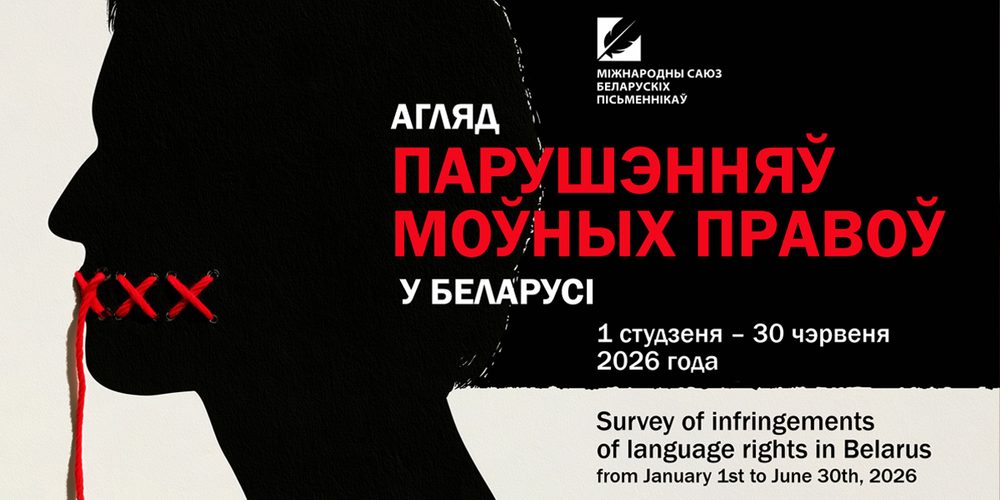
The survey of the first half of 2026 indicates the continuation of a systematic state policy, the result of which is the further narrowing of the scope of using the Belarusan language and the strengthening of the dominant position of the Russian language. This policy is manifested in state administration, education, informational and cultural spheres, public space and the service sector, as well as in the pressure on people and institutions that have to do with the preservation, development, usage, and popularization of the Belarusan language.
The main focus of the document is on the status of the Belarusan language. However, the survey includes individual recorded cases of restrictions on the use of other languages, if they indicate broader discriminatory practices and the de facto imposition of the Russian language as the dominant language. Such cases are not considered as a separate monitoring of the status of national minority languages, but as part of the overall picture of the implementation of language rights in Belarus.
A particularly worrying trend in the first half of 2026 was the strengthening of the repressive component of state policy towards the Belarusan language and culture. Public statements on the infringement of the Belarusan language were effectively put on a par with activities that are “not in the interest of the state” and manifestations of “extremist ideas” by the Minister of Information Marat Markov. Simultaneously, the persecution of representatives of the Belarusan book publishing and distribution sector continues, and publishing houses, book projects, and Belarusan-language publications fall under the scope of anti-extremist legislation.
The cases recorded within the framework of this monitoring allow us to highlight several key areas in which systemic discrimination against the Belarusan language, its exclusion from public life, as well as other forms of restriction of linguistic rights, are manifested most clearly:
Public administration and public space. The Russian language preserves its dominant position in administrative work, the activities of state bodies, and public infrastructure. The Belarusan language, despite its state status, in many cases remains de facto optional for state institutions and organizations.
Education. The narrowing of the Belarusan-language educational space is being accompanied by the strengthening of the dominant role of the Russian language. The survey records both individual cases of pressure in order to switch from Belarusan to Russian in the educational process, as well as general indicators demonstrating a significant imbalance between the two state languages.
Places of imprisonment. The Belarusan language is an additional reason for pressure and degrading treatment. There are recorded reports of demands to switch to Russian, insults and punishments in connection with one’s use of Belarusan.
Book publishing and distribution of Belarusan-language literature. During the first half of 2026, pressure on the independent book infrastructure, which plays a key role in the creation and distribution of Belarusan-language literature, significantly increased. There were mass detentions and searches of representatives of the book publishing and distribution sector; publishing and book initiatives were recognized as “extremist formations”, and books, websites and pages of book projects were recognized as “extremist materials”. These measures keep narrowing the possibilities for publishing, distribution and access to literature in the Belarusan language.
Public stigmatization of the language question. Of particular concern is the emergence in official rhetoric of a connection between statements about the infringement of language rights and “extremist ideas.” Such rhetoric not only denies the very problem of the unequal position of the Belarusan language, but also creates additional risks for the public discussion of language discrimination and the protection of language rights.
These trends need to be seen in a broader context of the restrictions of cultural rights and national identity in Belarus. In a report submitted to the UN Human Rights Council in June 2026, the UN Special Rapporteur on the situation of human rights in Belarus, Nils Muiznieks notes that the repressions in the country include a systematic restructurization of cultural space, education, language usage and historical narratives. Belarusan cultural and national identity, as well as linguistic affiliation, is increasingly perceived as signs of political opposition.
The survey covers the period from January 1st to June 30th, 2026 and was prepared by the Association “International Union of Belarusan Writers” based on an analysis of open sources: publications of independent mass media, materials of Belarusan and international human rights defending organizations, as well as documents of international organizations.
Due to the ongoing repressions and risks to people in Belarus, any safe and systematic information collection inside the country is significantly limited. Therefore, the cases documented in this survey do not reflect the full scale of violations of language rights, but only cover the facts and trends the information on which has become available from open and trustworthy sources.
The purpose of the survey is to document cases and practices that limit the possibilities of using the Belarusan language, to identify systemic trends in the field of language rights, and to draw the attention of the Belarusan and international community to the need for their protection as an integral part of cultural human rights.
On January 13th, 2026, the Belarusan Information Minister Marat Markov rejected a proposal to increase the share of Belarusan-language content on television to 45%. He stated that he did not see a public demand for the introduction of such quotas, and spoke out against regulating the ratio of Belarusan and Russian languages in television broadcasting.
In January 2026, a former political prisoner in correctional colony No. 15 in Mahilou informed human rights defending activists about restrictions on the study of foreign languages in the colony. According to his testimony, the administration paid special attention to educational literature in the Polish language, which was considered “hostile”. The presence of a Polish textbook could be a reason for a preventive interview and punishment of up to ten days in a penal colony. At the same time, the attitude towards educational literature in the English language was less strict. The testimony indicates a discriminatory attitude towards the use and study of certain languages in the penitentiary system.
January 24th, 2026. In the Kapyl Children’s Library, the windows were decorated with portraits and quotes from the Russian poets Alexander Pushkin, Sergei Yesenin, and Mikhail Lermontov. Belarusan writers were not represented in the exhibition. At the same time, the library is named after the Belarusan poet, translator, and journalist Anatol Astreika, a native of the Kapyl District; the Belarusan writers Ciska Hartny, Adam Babareka, and Ales Adamovic were born in this region, too. The case is an example of the dominance of Russian cultural content in the public space of a state cultural institution.
On January 29th, 2026, the Ministry of Internal Affairs of Belarus, by decision No. 2EK, recognized the public cultural campaign “Let’s be Belarusans!” as an “extremist formation”. The corresponding list included the cultural-educational media portal Budzma.org, the campaign pages on social networks and messengers, the bot-poster of Belarusan events @Budzma_razam_bot and other campaign resources. The decision of the Ministry of Internal Affairs also lists the campaign coordinators Alena Makouskaya and Nina Shydlouskaya as persons involved in the “formation”. The information on the decision was included in the list of the Ministry of Internal Affairs on February 3rd, 2026.
On January 30th, 2026, the Assistant Prosecutor of the Hlusk District, Olga Butkevich, in an official Russian-language commentary for a local newspaper, used the Belarusan phrase “protest movement” to explain the inclusion of the Facebook page “In the Center” Europe – Outskirts of the World” to the list of “extremist” materials. The Human Rights Center “Viasna” drew attention to the use of the Belarusan language in this context and assessed it as a manifestation of a contemptuous attitude towards the Belarusan language.
On January 31st, 2026, Nasha Niva published a material based on the testimonies of Belarusan-speaking users of the social network Threads about cases of discrimination and negative attitudes in connection with the use of the Belarusan language. In particular, a resident of Viciebsk reported that a gynecologist refused to see her and sent her to another doctor, other medical workers reacted negatively to her use of the Belarusan language, and at a government job she was forced to translate reports into Russian. Another participant in the discussion reported that in a kindergarten she was reprimanded for speaking Belarusan to children, and the head teacher demanded that she not speak Belarusan with colleagues in the presence of children. According to the participants in the discussion, cases of negative attitudes towards Belarusan-speaking people most often occur in medical and government institutions, schools and kindergartens, banks, and the service sector.
February 5th, 2026. In correctional colony No. 4 in Homiel, an officer of the operational department demanded that the imprisoned Latvian citizen Alla Sokolenko not speak Latvian with her son during visits. According to Sokolenko’s testimony, the officer threatened to translate the recording of their conversation and stated that the language of communication in the colony was Russian. The case testifies to the practice of effectively imposing the Russian language in places of imprisonment and restricting the ability to use a native language other than Russian.
February 10th, 2026. It became known that the new transport cards of the “Bus Park Hrodna” were released in Russian, although the design that won the open competition of the enterprise was originally in Belarusan. The author of the design, Ruslan Bubnovic, reported that at the request of the customer, language changes were made to the layout and in the final version, the Belarusan language was replaced with Russian. In response to a citizen’s request, “Bus Park Hrodna” stated that it adheres to the “principles of equality in bilingualism” and does not consider the use of Russian in the design of the cards to be a manifestation of the priority of one of the state languages.
On February 13th, 2026, the Human Rights Center “Viasna” published evidence of a negative attitude towards the use of the Belarusan language in places of detention. One of former political prisoners reported that Belarusan-language correspondence raised additional questions from officers, and one of them advised him not to speak Belarusan in the presence of patrol officers. According to the political prisoner’s testimony, he was also called a “fascist” for using the Belarusan language. Human rights activists note that the Belarusan language in places of detention is often perceived as a sign of disloyalty and political stance.
On February 14th, 2026, “Nasha Niva” published the story of Chinese citizen Xu Bailong, who studied Belarusan in China and then came to the Belarusan State University to continue his studies. According to his testimony, the university sent him to Russian philology because there was no adapted program for systematic study of the Belarusan language for foreign students, and Belarusan was taught only optionally – up to three hours a week. Some teachers demanded that their subjects be taken only in Russian, and one of the teachers directly asked Xu to answer in Russian. After his academic supervisor appealed to the administration, the student was given additional classes in Belarusan philology; as a result, he defended his thesis in Belarusan.
Xu also reported that when using the Belarusan language in Minsk, he encountered surprise, misunderstanding, and ridicule. He himself described such attitude as discrimination against the Belarusan language.
On February 16th, 2026, the State Security Committee of Belarus recognized Gutenberg Publisher as an “extremist formation”. It is a Belarusan publishing house registered and legally operating in Poland, specializing in publishing books and board games in the Belarusan language. The list of resources related to the “extremist formation” included the publishing house’s pages on Facebook, TikTok, Instagram, Threads, and Telegram. The information on this decision was included in the list of the Ministry of Internal Affairs and became publicly known on February 23rd.
February 17–18, 2026. A wave of searches and detentions of representatives of the Belarusan book publishing and book distribution sector took place in Minsk. On February 17th, at least 10 people were detained, including the head of the “Technology” publishing house Vaclau Bahdanovic, translator and publisher Zmicier Kolas, book distributor Ales Jaudacha, as well as members of the Bahdanovic family. During the search of the “Technology” publishing house, equipment was confiscated. Some of the detainees were sentenced to administrative arrests for 14–15 days. Later, some of the detainees were not released after the end of their administrative arrests and became subjects of criminal prosecution.
On February 18th, 2026, the Belarusan-language book by Elijas Bart, The Legend of the Stolen Heart, published by the publishing house “Technology” in 2023, was included in the national list of extremist materials by a decision of the Partizanski District Court of Minsk. The decision became known on February 26th. The inclusion of the book in the list entails legal restrictions on its publication, distribution and storage and may be grounds for administrative liability.
February 22nd, 2026. The Information Minister Marat Markov stated that both those who speak about the infringement of the Belarusan language in Belarus and those who declare the infringement of the Russian language “work not for the benefit of the state” and are “very close” to the manifestation of “extremist ideas,” since, according to him, they are trying to bring discord into society. Markov also stated that “both must be fought” and that the position of the Ministry of Information on this issue will be “very tough.”
February 22nd, 2026. On the social network Threads, parents of Belarusan schoolchildren drew attention to the fact that the subject “History of Belarus” is taught to their children in Russian, and expressed dissatisfaction with this practice.
On February 27th, 2026, a student at a technical university reported on the social network Threads about pressure in connection with choosing the Belarusan language to write her thesis. According to her, there was no formal ban, but she was persistently offered to write her thesis in Russian. Other participants in the discussion reported similar cases: demands to rewrite documents written in Belarusan in Russian, demands from teachers to complete academic work in Russian, as well as obstacles in the preparation and defense of Belarusan-language thesis.
On March 2nd, 2026, Pavel Sieviaryniec told the Human Rights Center “Viasna” that during his imprisonment, prison officers demanded that he speak Russian. In particular, in correctional colony No. 17 in Sklou, operational officers and controllers claimed that “normal Belarusans” speak Russian, and Belarusan-speaking people were allegedly “corrupted by Poles,” and demanded that Sieviaryniec switch to Russian.
On March 3rd, 2026, the State Security Committee of Belarus, by decision No. 4/8-455, recognized the so-called “coalition of print publishers” as an “extremist formation”. The list included the Kamunikat.org foundation, Lohvinau Publishing House, Andrei Januskievic Publishing, the publishing house “Zmicier Kolas”, as well as other publishers and distributors of Belarusan books operating in Belarus and abroad. The head of the Kamunikat.org foundation Jaraslau Ivaniuk stated that such a “coalition of print publishers” does not exist in reality. The KGB decision also mentions Zmicier Kolas, Vaclau Bahdanovic and Ales Jaudacha, who were in custody in Belarus at the time; according to Radio Svaboda, the document suggests that criminal cases have probably been opened against them.
On March 11th, 2026, the Minister of Education Andrei Ivanets stated that Belarus is ready to actively support initiatives to popularize and expand the use of the Russian language and become a platform for holding relevant international events. According to Ivanets, the Russian language is “as native as Belarusan”, as well as “in many ways our cultural code” and part of a common cultural and historical space.
April 2 – June 10, 2026. The Ministry of Information suspended the certificate of a distributor of printed publications of the publishing house “Technology” – the first private publishing house in Belarus, founded in 1988. The formal reason was the missed deadline for submitting a notification of changes to information subject to inclusion in the state register. Earlier, in February 2026, representatives of the publishing house were subject to a wave of detentions and searches in the Belarusan book industry.
On June 10th, 2026, the Minsk City Economic Court recognized the publishing house “Technology” as an “extremist organization.”
On April 14th, 2026, a new public transport stop was installed in Homiel near Janka Kupala Park, the name of which was indicated on the information sign exclusively in Russian. The case is another example of the dominance of the Russian language in the design of public urban infrastructure.
On April 15th, 2026, the football club “Naftan-Novopolotsk”, in response to an appeal by the human rights defending activist Ihar Slucak regarding the use of the Belarusan language in the club’s activities, stated that the club’s use of the Russian language does not violate the rights of citizens.
On April 6th, 2026, the Philological Faculty of the Homiel State University named after Francysk Skaryna announced the expansion of cooperation with the Russian state foundation “Russian World”, which activities are aimed at promoting the Russian language and culture outside Russia. During the visit of the foundation’s representative Sergei Ulitin to the university, the opening of a special branded audience of “Russian World” at the Philological Faculty was discussed, and methodological literature on Russian as a foreign language was also transferred. The visit took place within the framework of the “Days of the Russian Language”, which included events for students and schoolchildren.
On April 17th, 2026, the Kamianiec District Executive Committee, in response to an appeal by the human rights defending activist Ihar Slucak regarding the use of Belarusan on public transport tickets, announced that the use of Belarusan on travel documents in the city was not planned.
April 22nd, 2026. It became known that the Minsk cafe Mon Nom, which previously offered menus in Belarusan, Russian, and English, has stopped using the Belarusan version of the menu. The restaurant’s employees explained this by the lack of demand for it: according to them, visitors have not recently requested a Belarusan menu.
March 23rd, 2026. The Partizanski District Court of Minsk recognized the Knihi.by website and Instagram page as “extremist materials”. It is an online store of Belarusan literature founded by the book distributor Ales Jaudacha, who was detained on February 17th during a wave of persecution of representatives of the Belarusan book publishing and distribution sector. After his detention, the online store stopped operating.
On May 7th, 2026, the Belarusan online library Kamunikat.org, which contains more than 70 thousand Belarusan publications — books, newspapers, magazines, audiobooks, video and audio materials — became the object of a large-scale hacker attack and temporarily stopped working. According to the project manager Jaraslau Ivaniuk, as a result of the attack, the library’s servers were effectively wiped clean. The restoration of the website took more than a month; by June 19th, the library was almost completely restored.
Ivaniuk suggested that the attack could be linked to Belarusan special services. Previously, the Kamunikat.org website was blocked in Belarus, and on March 3rd, 2026, the Kamunikat.org foundation was included by the KGB in the so-called “coalition of print publishers”, recognized as an “extremist formation”. After the cyberattack, the Polish Cybercrime Service opened a criminal case.
On May 17th, 2026, Brest residents noticed that the electronic information boards in trolleybuses on some routes displayed inscriptions exclusively in Russian. After the publication of the corresponding video on social networks, users expressed dissatisfaction with the disappearance of the Belarusan language from the elements of the city’s transport infrastructure.
On May 18th, 2026, the language of travel documents on public transport in Lepiel was changed from Belarusan to Russian. In response to an appeal regarding the return of the Belarusan language on tickets, the transport company reported that it has no plans to restore the Belarusan-language version.
May 21st, 2026. On the website of the Jakub Kolas Central Scientific Library, the material dedicated to the 115th anniversary of the Belarusan writer Vasil Vitka was published exclusively in Russian, including in the Belarusan-language version of the website. As illustrations, the library used only Russian-language editions of the writer’s works, who wrote in Belarusan. In the library’s Telegram channel, the author’s name was given in the Russified form “Vasiliy” Vitka, and the name of the Belarusan children’s magazine “Viasiolka”, of which Vitka was the editor-in-chief for 17 years, was additionally translated into Russian as “Rainbow”.
June 1st, 2026. In Polacak, on the occasion of the City Day, new entrance signs were installed at key entrances, the name of the city on which is given exclusively in Russian – “Polotsk”. The new signs were officially presented as a “business card” of the oldest city in Belarus, designed to emphasize its history and cultural heritage. The absence of the Belarusan language on the new signs caused criticism from some of the city’s residents.
On June 8th, 2026, the National Institute for Knowledge Control published the results of the centralized exams of 11th grade graduates in state languages. 10,417 graduates (17.69%) chose Belarusan for the exam, 48,456 (82.3%) chose Russian. 125 people received the maximum 100 points in Belarusan, and 1,301 in Russian.
Compared to 2025, the results in the Belarusan language have worsened: the number of graduates who received 100 points decreased from 264 to 125, and the average score from 65.62 to 63.85. In Russian, on the contrary, the number of graduates increased from 715 to 1,301, and the average score increased from 62.62 to 66.16.
On June 30, 2026, the human rights defending activist Ihar Slucak reported that in 2026, office work in the Mahilou District Executive Committee was conducted in Russian. According to the information he received, about 10% of the legal acts of the district executive committee were adopted in Belarusan.
The association International Union of Belarusan Writers will continue to monitor the state of linguistic rights in Belarus, record new cases of their violation, and track trends in this sphere.
We ask you to report to us any cases of discrimination or restrictions on rights related to the use of Belarusan or other languages in Belarus. Such information will help us to more fully document the real situation and to take into account cases that are not covered in open sources.
You can report the incident by email: naszamova@gmail.com.
All information received will be used with security and confidentiality requirements in mind.
Агляд парушэнняў моўных правоў у Беларусі з 1 студзеня па 30 чэрвеня 2026 году (BEL)
Обзор нарушений языковых прав в Беларуси с 1 января по 30 июня 2026 года (RU)


